
Custom Antenna Design
Tailored antennas maximizing performance, overcoming constraints, reducing BOM, and improving reliability.
Cellular antenna design
Over the past few decades, the evolution of cellular networks, from 2G and 3G to 4G LTE and now 5G, has significantly driven advancements in antenna technology and design. These developments, initially spurred by the need for improved phone communication, have expanded to encompass smartphones, IoT sensors, wearables, and various other applications, increasing demand for specialized LTE antenna design solutions.
Cellular 4G LTE and 5G systems operate within frequency bands licensed by cellular operators, in contrast to other systems that utilize ISM bands. This results in a wide variety of frequency bands used in cellular systems, which vary globally. Designing antennas that cover multiple frequency bands requires 2, 3, 4, or even multiband antennas. These antennas are generally more complex and sensitive to errors and necessitate more space than single-band antennas. These complex structures make LTE antenna design particularly sensitive to layout, device size, and frequency allocation.
Different frequency ranges experience their own design challenges.
Frequencies below 1GHz are the most difficult to cover in small devices. Size of the ground plane, often the pcb gdround layer, is the limiting factor. LTE and 5G antenna design for low-band focuses on maximizing utility of ground plane while adapting to use case of the device (for example: on metal, on wrist etc.).
Unlike low bands, the mid band performance is not as often limited by ground plane size. Typical challenges are resonce created on other parts of the device by mechancis or electronics. Radiation pattern can start to differ from famous "donut" shape which can cause new challenges depending on the use case.
Performance and design challenges of high band come from the finest details of PCB layout and material selection. PCB features such as ground tiching, impedance of trace transitions and material losses are important to have under control.
Beside typical integration environment and use case challenges that related to all antennas the LTE and 5G antenna designers have to tackle set of unique design goals to ensure reliable connectivity, high data rates and access to market.
The quality of a cellular network connection is closely tied to the performance of the user equipment (UE), such as smartphones, connecting to the network. A poorly performing antenna can lead to perceived limited coverage, affecting the user experience and, consequently, the reputation of the network operator. This is why many network operators have stringent performance requirements for devices on their network, focusing on metrics such as Total Radiated Power (TRP) and Total Radiated Sensitivity (TRS/TIS).
For devices not bound by operator requirements, benchmarking against market competitors is crucial. Aalborg University has conducted studies on the performance of recent mobile phones, providing valuable insights for antenna design.
In addition to network operator requirements, government regulators impose performance limits for public safety and interoperability. These limits are not exclusive to cellular systems but, when combined with high-performance requirements, can complicate antenna design. Key criteria include Specific Absorption Rate (SAR) and Effective Isotropic Radiated Power (EIRP), which necessitate user body shielding and omnidirectional radiation to meet safety standards. These criteria vary by country and device type. Navigating these regulatory demands requires LTE/5G antenna design expertise that ensures compliance without compromising device performance.
Modern LTE and 5G standards incorporate diversity and multiple-input-multiple-output (MIMO) antennas. Diversity antennas, with different radiation characteristics from the main antenna, enhance connection reliability and enable higher data rates. MIMO systems can include 2, 4, 8, or more reception antennas (Rx-MIMO), and sometimes multiple transmission antennas (Tx-MIMO), to improve reception sensitivity and data rates.
LTE and 5G feature that increase datarates and complicates antenna design is carrier aggrecation. A popular approach for achieving higher antenna performance especially for low bands is active tuning where antenna properties are changed according to the specific band that is used at the time. With carrier aggrecation this becomes more challenging because the combinations of bands that has to be supported at once can get rather complex.
Services
Radientum offers specialized 4G LTE and 5G antenna design services, from feasibility studies and various design stages to consultancy during mass production. Our antenna simulations provide accurate performance forecasts in early development stages, enabling informed decisions before prototype manufacturing, especially in demanding LTE antenna design scenarios. We leverage our extensive product integration expertise to develop innovative antenna solutions.
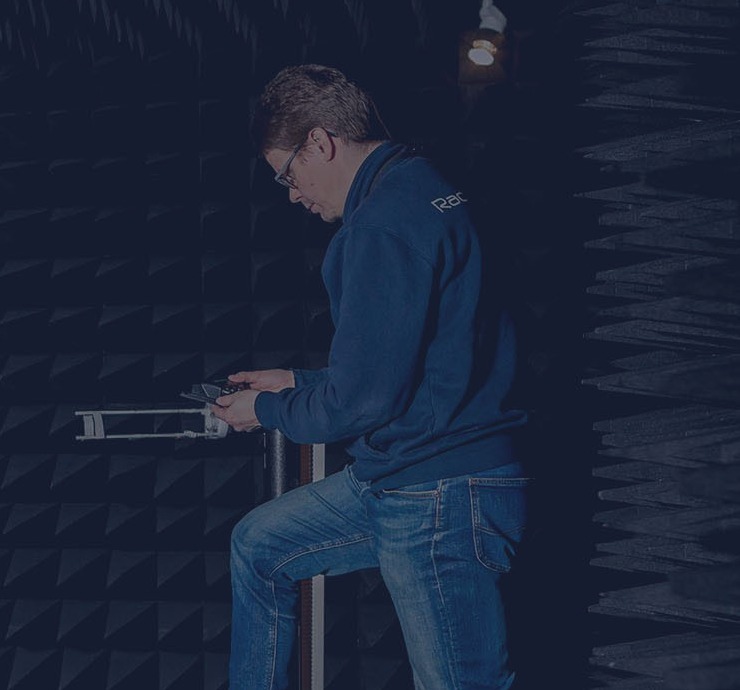
We also conduct TRP and TRS measurements for 4G LTE systems in our own anechoic chamber using a communication tester, with a Test-SIM card being the only requirement to commence testing.
You have a vision of a wireless product. So, you know how the product should look like, what materials will be used, what’s the desired sensing experience, and more. The first thing is to find out how these requirements affect antenna design and is the vision realistic. Feasibility Study enables you to do just that!
Reference project
Discover how Round Solutions and Radientum collaborate to create internationally certified industrial IoT devices, enhancing reliability and customer satisfaction in the market.
Radientum offers wide range of antenna, RF and EMI/EMC related services to companies developing products with cellular LTE or 5G communication.
Here are few antenna manufacturing technologies commonly used in cellular LTE and 5G devices.
Here are few other communication related RF technologies you should be aware of.