
Read time 8 min
What Are TRP and TIS? Understanding Over-the-Air Antenna Testing
Antenna TestingAntenna
When designing mm-wave 5G device, engineers have to compline with specific limits and metrics according to industry standards and safety protocols. The two most important metrics in 5G mm-wave antenna design are CDF EIRP and sPD.
Effective Isotropic Radiated power (EIRP) is a measure of the power in dBm in a specific direction. When working with lower frequencies, Total Radiated Power (TRP) is the metric, that describes antenna’s performance, but it is not sufficient on mm-wave range, as multiple arrays with beam steering are involved in creating the total coverage. CDF gives the cumulative probability that the EIRP will be less than a given value. It can be estimated both for a single beam and for a combination of beams.
The simulated 5G mobile phone has three antenna arrays: two 1x4 and one 2x2 (dual-polarized). 2x2 dual-polarized array operates at 27.5GHz, while two 1x4 arrays – at 28.35GHz. Each antenna has several scanning positions, which results in total scan patterns shown on Figure 1.
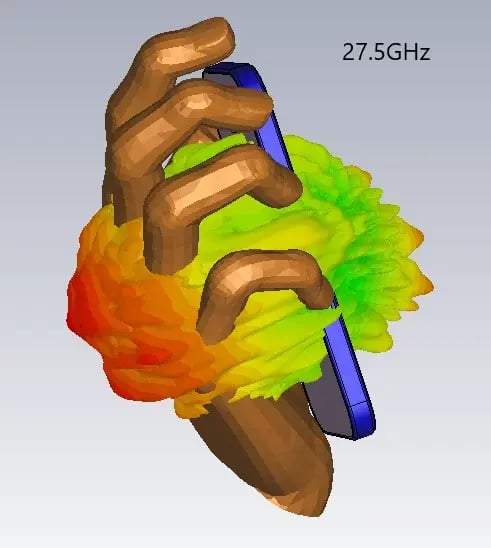
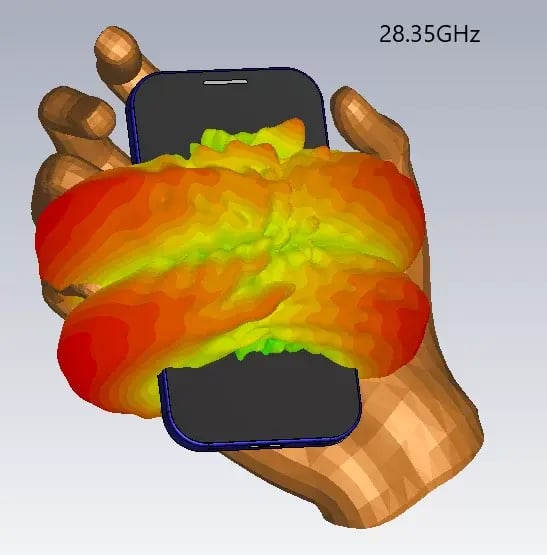
Figure 1. Total Scan Pattern at 27.5GHz (left) and 28.35GHz (right)
CDF EIRP plot for 27.5 GHz is shown on Figure 2. Dark blue line represents 50% EIRP, light blue line represents peak EIRP.
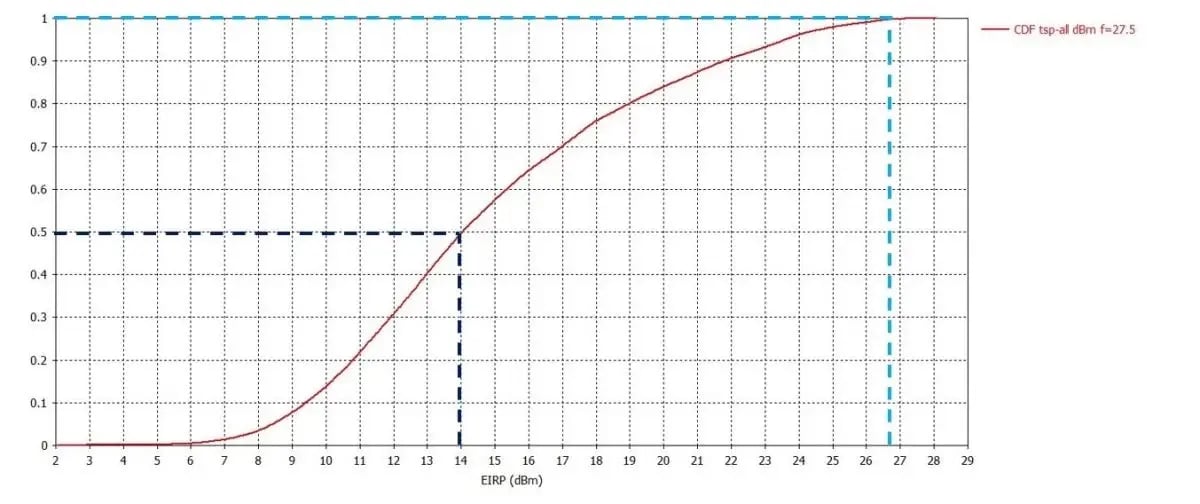
Figure 2. CDF EIRP at 27.5GHz
The plot is meant to be read like this: there is a 50% chance that EIRP will be less than 14 dBm, and there is 100% chance that EIRP will be less than 26.8 dBm. Meaning that 26.8 is the Peak EIRP for this case.
Table 1 represents 3GPP requirements for power Class 3 devices in 5G NR. Mobile phone is considered as a Class 3 Device.

As follows from the table 1, the most important values are CDF EIRP (0.5) and CDF EIRP (1).
Most RF engineers are familiar with SAR (specific absorption rate) standards, that regulate wireless devices operation on lower frequencies. The industry standard that regulates limits for human exposure at 5G mm-wave is Spatially Power Density.
sPD is Spatially Averaged Power Density. It averages the power density over very small tiles usually specified as 4. Normally engineers estimate power levels at different distances near a radiating device, say at 2, 10 and 20mm from the simulated antenna. Figures 3, 4 and 5 feature sPD for each of three antenna arrays in the simulated mobile phone.
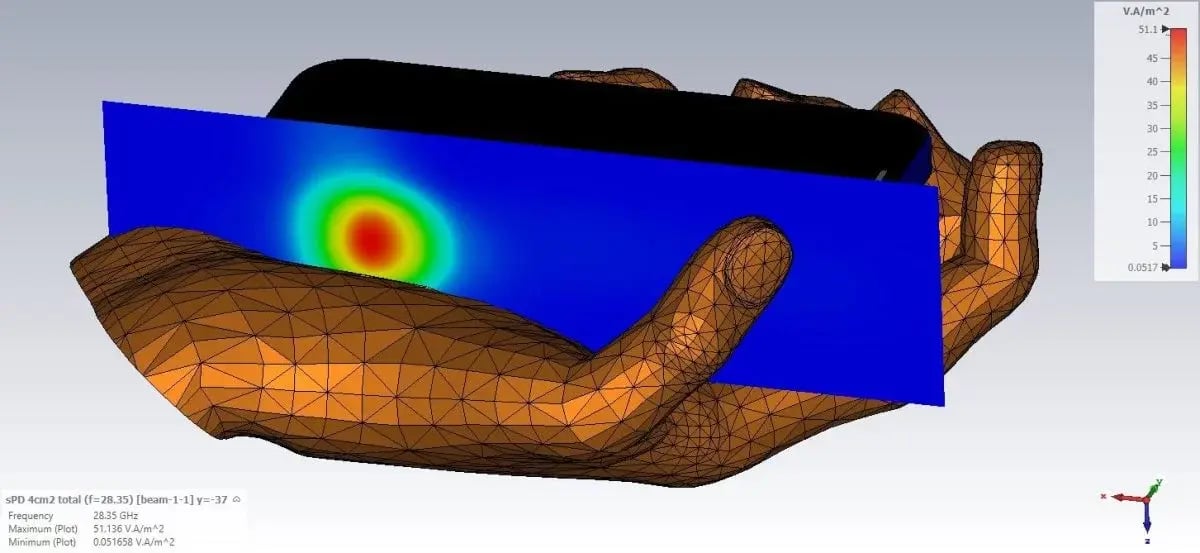
Figure 3. sPD along Y axis, right side 1x4 array 28.35GHz
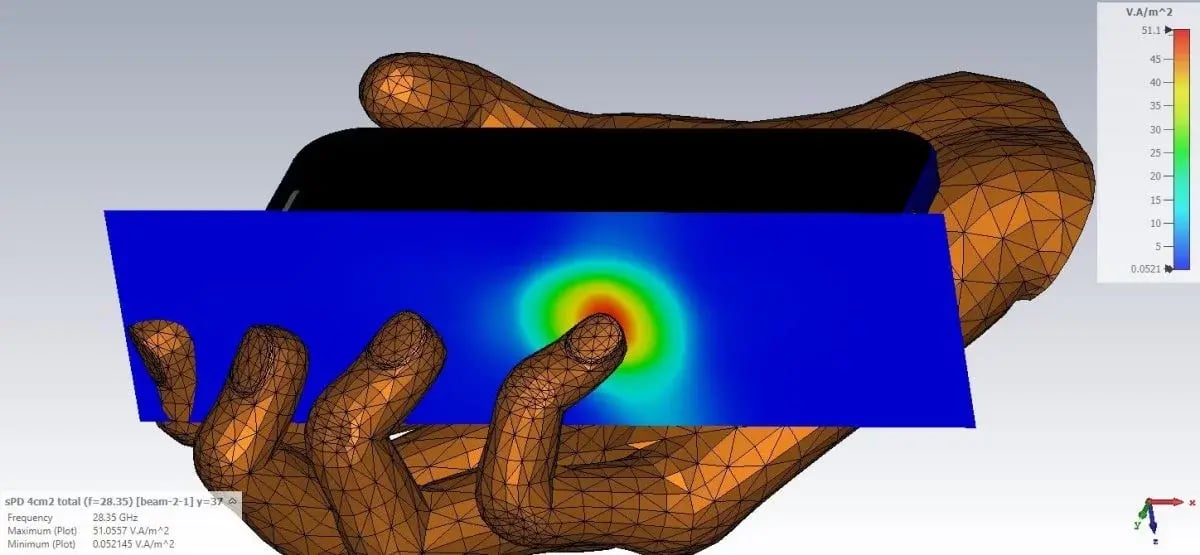
Figure 4. sPD along Y axis, left side 1x4 array 28.35GHz
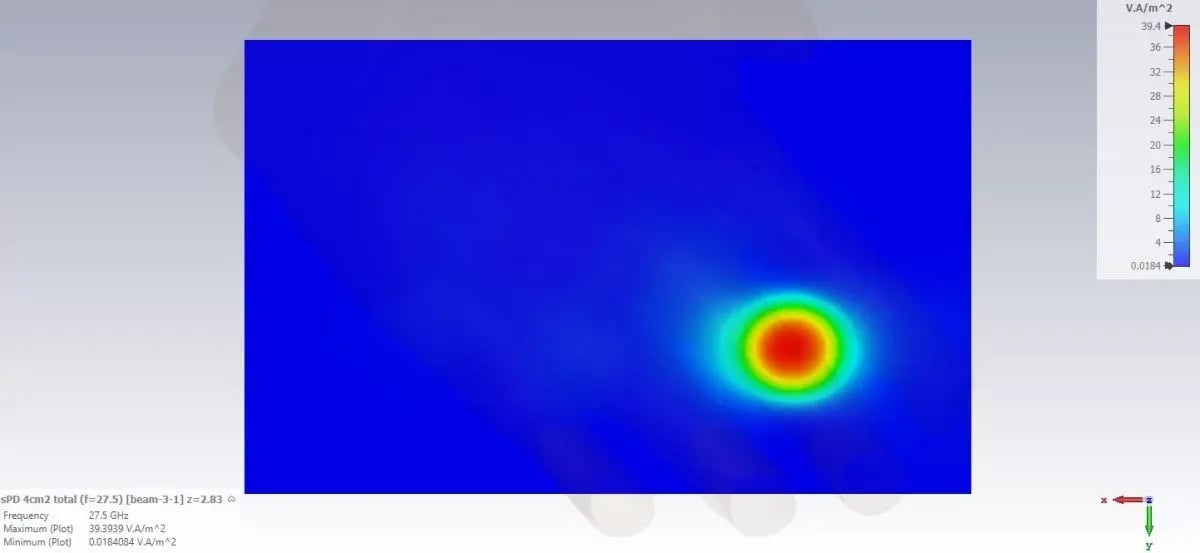
Figure 5. sPD along Z axis, 2x2 array 27.5GHz
Both metrics are different from the accepted standards on lower frequencies, so they require a thorough approach while concepting and simulating 5G mm-wave device.
Disclaimer: The views and opinions expressed in this article are those of the author. It is intended only as a sharing of antenna design knowledge for educational purposes.