

Read time 9 min
Antenna Design as Part of a Product Project: When to Start and What to Share
Antenna
Quick answer: An off-the-shelf (chip or module) antenna is usually the faster, lower-NRE choice when your product can follow the antenna vendor's layout rules: enough ground plane and clearance, and no metal close to the antenna. A custom antenna pays off when the mechanics break those rules, when one antenna must cover several bands, or when volumes are high enough that removing the antenna component lowers BOM cost. In one Radientum test at 699–960 MHz, a metal display frame dropped an off-the-shelf antenna's efficiency from 30% to 3%, while a custom antenna in the same setup reached 25%.
When you are developing a connected, wireless product, the antenna is one of the most critical design areas. Because the user experience depends on how well your product connects! Whether you are making an IoT device, smartphone, or smart ring, you can choose between two alternatives: design a custom antenna, or use an off-the-shelf (OTS) antenna. Both have their pros and cons. This guide compares them on cost and performance, shows measured data from a real layout, and explains when each one is the better choice.
An OTS antenna performs as specified when the product follows the vendor's reference layout: the ground plane size, the clearance area and the distance to metal parts. OTS antennas can lower the cost for designing (simulations and optimization) and manufacturing (tooling and testing) of the device. A wrong antenna choice lowers the reliability and overall efficiency of the device.
An OTS antenna is usually the better choice when:
• the PCB has room for the vendor's recommended ground plane and clearance
• no metal (display frame, battery, shielding can, screws) sits close to the antenna
• the product covers one or two bands, for example Bluetooth or 2.4 GHz Wi-Fi
• volumes are low or the schedule is tight, so low NRE matters more than BOM cost
Radientum's standard antenna integration service covers placing and tuning an OTS antenna in your product.
When the mechanics or the band plan break those rules, a custom antenna becomes the better option. The comparison below shows the trade-offs.
In ideal conditions, both antenna types can perform excellently
A matching circuit is often needed to attain correct input impedance and excellent performance. Usually, the standard antennas have enough ground plane surface to neglect the external interference, but in wearables and IoT devices, antenna designers must work around the limited ground plane and circuit effects.
To keep costs down, engineers try to optimize the PCB with a thinner layer stack and avoid the expensive materials such as Rogers materials.
Before recommending either option, Radientum's engineers check:
Table 1. Off-the-shelf vs custom antenna
| OTS Antenna | Custom Antenna | |
|---|---|---|
| NRE cost | Low | High |
| BOM cost | High | Low |
| Performance (following design rules) | Excellent | Excellent |
| Performance (breaking design rules) | Poor | Good |
| Durability | Product dependent | Good |
As the number of IoT devices and consumer electronics connecting over Wi-Fi grows, the complexity of wireless devices is also increasing, which limits the antenna size and placement.
Depending on the performance target, the antenna can sit inside the device, on the PCB or outside the enclosure. For example, a smartphone can have six or more antennas, all packed inside the body to support calls, Bluetooth, Wireless Fidelity (Wi-Fi), Long Term Evolution (LTE) wireless communication standard, Global Positioning System (GPS), Near-Field Communication (NFC).
In the wearable industry, special materials for antenna designing have been introduced according to the application. Antenna size, placement and material characteristics for environmental ruggedness in wireless communication lead the antenna engineers to the development of custom antennas that meet the requirements of the customer with respect to their application.
In the pictures below, there are three different situations. First is an example of an off-the-shelf (OTS) antenna on plain PCB with antenna appropriate clearance. The second is the same OTS antenna on a PCB with a metal display frame, followed by a custom antenna with the same display frame.
Table 2 compares their efficiencies.
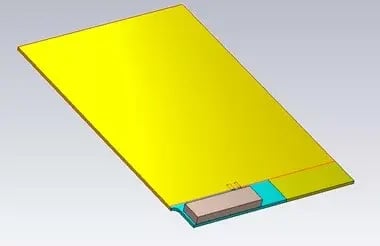 |
Figure 1. Off the Shelf Antenna on plain PCB Off-the-shelf antenna on a PCB that has metallic display frame under the antenna which contradicts design rules. |
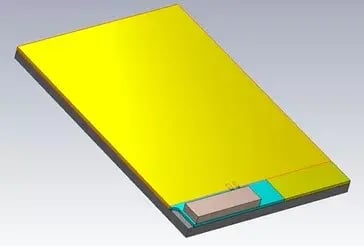 |
Figure 2. Off the Shelf Antenna on PCB and metallic display frame Custom antenna with PCB and display frame that contradicts off-the-shelf antenna design rules. |
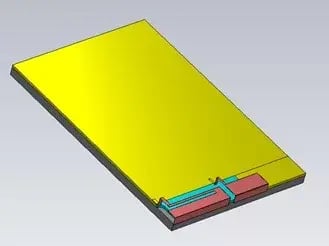 |
Figure 3. Custom antenna on PCB and metallic display frame |
The off-the-shelf antenna works well on plain PCB, which provides the environment the antenna is designed to operate in. Once the metal display frame is introduced, it covers the antenna clearance on the PCB and changes the antenna environment, this causes the performance to drop significantly. With a custom antenna design, the antenna volume can be optimized using all the space available from mechanics, and performance is improved.
Table 2. Measured antenna efficiency, 699–960 MHz
| Antenna Efficiency (699-960MHz) |
|
|---|---|
| OTS antenna on plain PCB | 30% (-5dB) |
| OTS antenna with display frame | 3% (-15dB) |
| Custom antenna with display frame | 25% (-6dB) |
In this test, the metal frame cut the OTS antenna's efficiency from 30% to 3%, a 10 dB loss. The custom antenna reached 25% in the same mechanics.
With any wireless device, the quality of connectivity has a huge impact on the user experience and on how your product succeeds in the market.
Here are 5 reasons why a custom antenna enables you to create a better product – compared to taking a shortcut with an OTS antenna:
Wireless connectivity is becoming ubiquitous. IoT devices are equipped with wireless connectivity because it simply is more cost-efficient. More often than not, consumer products are enabled with wireless connectivity to deliver greater user experiences. However, competition is fierce and only those devices and products with smooth and robust wireless connectivity can win customers’ hearts! This comes down to how well your antenna performs.
Start with an off-the-shelf antenna if your layout can follow the vendor's design rules and the product covers one or two bands. Choose a custom antenna when metal parts, a small ground plane or several bands break those rules, or when volumes make the BOM saving worth the NRE.
Not sure which fits your product? Contact Radientum with your mechanics and band list, and our antenna engineers will assess whether an off-the-shelf antenna will work or a custom antenna design is needed.
Disclaimer: The views and opinions expressed in this article are those of the author. It is intended only as a sharing of antenna design knowledge for educational purposes.