



3D printing or additive manufacturing has been around since 1980s. At first, it was seen as a way for fast prototyping. In recent years, it has been increasingly popular manufacturing method in a wide range of commercial and industrial applications. In general, 3D printing refers to methods where a component/part or even a product is built by adding material layer by layer. Some of the common techniques include FDM (fused deposition modelling), SLA (stereolithography), and SLM (selective laser melting).
Recently, antenna and RF community has studied 3D printing as a fabrication method, and it is seen as a viable option, for example, in aerospace applications. The antenna types vary from planar antennas to horns, dielectric lenses, and resonators. Some of the materials used include different plastics, ceramics, and metals. The utilized frequency ranges for 3D printed antennas range from sub-6 GHz all the way to millimetre wave bands such as Ku and Ka bands.
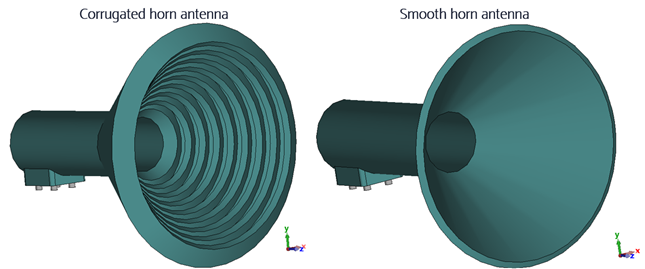
Figure 1: Corrugated and smooth horn antenna.
Advantages and Disadvantages of Antenna 3D Printing
As with all manufacturing methods, additive manufacturing of antennas has its advantages and disadvantages some of which are listed below.
Additive manufacturing advantages:
- Fast prototyping
- Cost-effective manufacturing method
- Complex 3D shapes for antennas are possible
- Lightweight antenna structures possible
- High material utilization
Additive manufacturing disadvantages:
- Surface accuracy
- Tends to be more lossy
- Limited material selection
- Limited mass production
- Size constraints
Advantages of 3D printed antennas
3D printed antennas are fast for prototyping, especially with in-house printers, as the printing process as a whole can be faster when compared to CNC milling or injection moulding processes. Furthermore, it may be more cost-effective to 3D print antennas if small batches are required. For example, injection moulding requires the design and fabrication of a proper mould which may be relatively costly for small manufacturing quantities.
Depending on the complexity of the design, CNC milling may require several laborious steps, but 3D printing can potentially handle the production of a complex part with a single printing process. And in some cases, 3D printing may enable shapes and geometries that are difficult to produce with other technologies. However, it is case dependent if 3D printing can provide cost and time benefits compared to more conventional manufacturing technologies. As a general rule, mechanically more complex designs are likely better suited for fabrication with 3D printing.
One of the advantages of 3D printing is that it enables lightweight structures. This is one of the reasons for its popularity in aerospace applications. For example, a fully metallic horn antenna can be manufactured using plastic which is metallized to achieve suitable RF-performance, or metal printed antenna can purposefully have voids to decrease weight. Printing lightweight structures also effectively utilizes the printing material as there is no need to remove material.
The downsides of 3D printing antennas
There are also some constraints for 3D printed antennas. The 3D printed antennas have a limited size due to the printing process. Therefore, some electrically large structures or low-frequency applications might not be possible with a single printing process.
Another disadvantage is the accuracy that the printing process can produce. Accuracy denotes both the capability to produce tiny details and the how smooth the surfaces are. Traditional manufacturing technologies typically yield designs with better accuracy. Reduced surface accuracy has detrimental effect to the antenna performance, being typically more significant issue at higher frequencies.
Lastly, 3D printing has more limited selection of materials that have desired mechanical and electrical properties. Mass production is limited with 3D printing as well but on the contrary, it enables agile and fast changes in the production.
3D Printed Antennas
Both academia and industry have been interested in 3D printed antennas or at least using 3D printing as part of antenna manufacturing. The typical materials used in printing incorporate different plastics (PLA, ABS), ceramics and metals. Some of the manufactured antenna designs may require post-processing such as surface polishing or metallization.
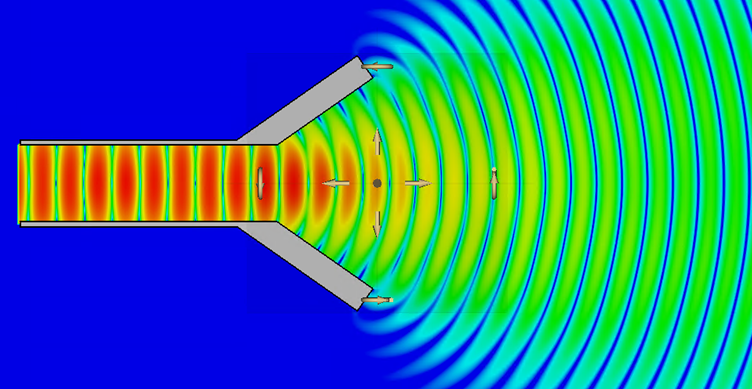
Figure 2. Horn antenna electric field.
Since printing allows 3D shapes, it is no surprise that it has been used for manufacturing dielectric lenses and resonators, horn antennas, dielectric reflector arrays, and complex 3D antenna shapes. Also, planar antennas have been demonstrated with 3D printing technology.
Dielectric lenses and resonators do not necessarily require metallization which may allow a simple printing process. The process also allows to control the permittivity of the lenses and resonators while using a single material. The permittivity can be varied to some extent with infill ratio, which refers to how much of the structure is filled with the material. When infill ratio is decreased the printed design contains more voids filled with air. This effectively decreases the effective permittivity.
Metallic horn antennas have been demonstrated using different 3D printing techniques. Horn antenna can be made lightweight by printing it from plastic. However, this requires metallization of the surface to enable RF-performance. Metallization can be achieved by utilizing a few different techniques. Antenna can be coated with metallic ink/paint using airbrush, for example. However, metallic inks/paints tend to have limited conductivity compared to solid metals. Conductivity may be improved by electrodepositing another metal layer on top of the metallic ink/paint. Even after another metallization it is typical that the achieved metal is more lossy than for example a typical PCB trace. If lightweight structures are not essential, horn antennas can be directly printed from metal alloys such as aluminium alloys. Direct metal printing can be achieved by, for example, using SLM which has metal as powdered substance which is melted with a laser.
Radientum and 3D antenna printing
We here at Radientum are always looking for the most effective ways to help our partners bring better-performing antennas to market. This is also why we have investigated 3D printing as a manufacturing technology. Figure 3 below, shows different horn antennas and a horn antenna array that were manufactured using metallic 3D printing technology. The metallic horn manufacturing was done by a service provider specialized in 3D printing. The smooth and corrugated horn antennas operate on Ku-band (12-18 GHz), and they were printed as single piece structures. The Ka-band (26.6-40 GHz) array was printed in two parts which were attached together with screws. Making a simulation model of 3D printed structures is more difficult than traditional materials since the material properties are not well known and may also depend on the printing process. For example, the simulation model usually does not include surface features of the printed antenna coming from printing process. These surface features may decrease antenna efficiency, for example. Although the designed Ku- and Ka-band antennas were simulated with smooth surfaces, the simulated gain matches well with the measured one for both Ku- and Ka-band antennas. The deviation was around 1-2 dB suggesting that the surface features do not significantly affect horn antenna efficiency.
If you are exploring 3D printing for antennas, we can support you with:
- Feasibility studies and design concept evaluations
- Antenna designs optimized for additive manufacturing
- Simulation and verification
- Integration of 3D-printed antennas into your overall system
We are happy to help. Whether you have just an idea or are already deep into development, we can guide you toward the right solution. Get in touch to tell us about your project.
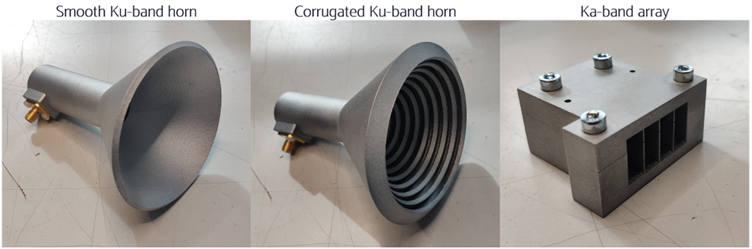
Figure 3. 3D printed Ku- and Ka-band antennas.
Conclusion
3D printing of antennas is gaining popularity especially in aerospace applications due to lightweight and complex shape solutions that it can provide with reasonably low cost. Current 3D printing technologies allows use of plastics, ceramics, and metals for antenna manufacturing. The accuracy of 3D printing varies based on the chosen method, and low accuracy can lead to reduced RF-performance. 3D printing is an alternative to traditional manufacturing methods, such as injection moulding and CNC milling. It is a good option for fast prototyping, but large-scale manufacturing between printing and other options should be carefully considered.
Disclaimer: The views and opinions expressed in this article are those of the author. It is intended only as a sharing of antenna design knowledge for educational purposes.
About the Author: Riku Kormilainen
Riku Kormilainen is an experienced antenna engineer at Radientum, specializing in the design and development of advanced antenna solutions. With a strong background in radio frequency (RF) engineering and an interest in innovative manufacturing techniques, he has been involved in versatile and demanding antenna design as part of Radientum engineering team.




Leave A Comment