



If your team is designing a connected wearable, one of the earliest and most consequential decisions you will face is which cellular technology to build around. Get it right, and your device ships with the right balance of coverage, battery life, data throughput, and hardware footprint. Get it wrong, and you are looking at costly redesigns or a product that simply does not perform in the real world.
This post gives you a practical, side-by-side view of four technologies that regularly come up in wearable development: NB-IoT, LTE-M, LTE Cat 1bis, and LTE Cat 4. We will compare them across the dimensions that matter most when your device is going to live on someone’s body, and we will share a concrete use case for each to illustrate where each technology earns its place.
The Dimensions That Matter for Wearables
Before diving into the technologies, it helps to be explicit about the evaluation criteria – because for wearables, the trade-offs look different than they do for fixed industrial IoT or smartphone design.
Network coverage – Wearables go wherever people go. Your device needs to maintain connectivity in urban buildings, basements, rural areas, and everywhere in between.
Data rate – Some wearables only need to trickle small packets of sensor data. Others stream audio, video, or large health datasets. Data rate requirements vary enormously.
Latency – For wearables with real-time feedback loops – alarms, voice, interactive responses – how quickly data moves through the network matters as much as how much of it can move.
Power consumption – Battery space is precious on any wearable. Cellular radios are frequently the dominant power draw, and the technology you choose sets the floor for battery life.
Number of antennas – Every antenna needs physical space, a ground plane, and clearance from the human body and other components. Fewer antennas mean a simpler integration problem.
Radio module size – The cellular module occupies PCB real estate you simply do not have in abundance. Smaller modules open up more design flexibility.
Module cost – At scale, the cellular module is often the highest-cost component on the BOM. The right technology for the job is rarely the most expensive one.
FOTA capability – Firmware-over-the-air updates are not optional for any device that will be in the field. How well a technology handles large firmware downloads – reliably, efficiently, without draining the battery – is a real-world constraint that gets underestimated early in development.
NB-IoT – Lean, Long-Lived, and Location-Limited
NB-IoT (Narrowband IoT) was designed to do one thing exceptionally well: keep devices connected and alive for years with virtually no data to send. It operates within existing LTE spectrum using a 180 kHz channel, which is how it achieves its remarkable deep indoor and rural penetration – up to 20 dB of additional link budget compared to standard LTE, the best coverage of any technology in this comparison.
| Dimension | NB-IoT |
|---|---|
| Network coverage | Excellent – best deep indoor and rural penetration |
| Data rate | ~26 kbps DL / 62 kbps UL |
| Latency | High – suited to infrequent, non-time-critical messages |
| Power consumption | Extremely low – PSM and eDRX enable years on a small battery |
| Number of antennas | 1 |
| Radio module size | Very small |
| Module cost | Lowest of the four |
| FOTA capability | Limited – low throughput makes large firmware updates slow and battery-intensive |
The important caveat for wearable teams: NB-IoT was not designed for mobility. Seamless handover between cells is either limited or not supported depending on the network. If your device stays largely stationary – or moves slowly within a stable coverage area – this is not a problem. If it is going to move quickly through multiple cells, NB-IoT will struggle.
A second practical note: FOTA is difficult on NB-IoT. Low throughput means large firmware images take a long time to transfer, and that transfer time costs battery. For devices with simple, infrequently updated firmware, this is manageable. For anything with a more complex or frequently updated software stack, it becomes a real operational burden.
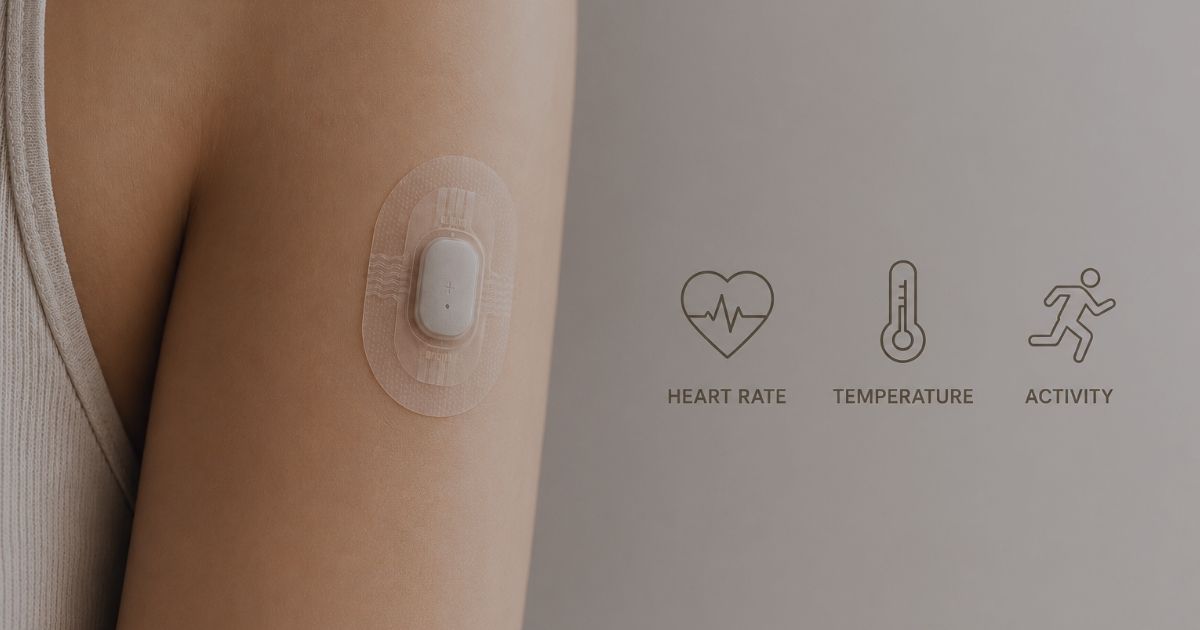
Example use case for NB-IoT: continuous health monitoring patch
A disposable biometric patch worn for multi-day monitoring in a hospital or home care setting. The patch transmits heart rate, temperature, and activity data in small periodic bursts. It never leaves a defined area, battery life is the primary constraint, data volumes are minimal, and firmware updates are infrequent and small. NB-IoT is a natural fit: the lowest module cost, the smallest possible footprint, a single antenna, and years of theoretical battery life. The deep indoor penetration means it keeps reporting even from inside a building where LTE signal would be marginal.
LTE-M – The Sweet Spot for Mobile Wearables
LTE-M (also called Cat-M1) is where most modern consumer and medical wearables land, and for good reason. It retains much of NB-IoT’s power efficiency while adding real mobility support, higher data rates, lower latency, and voice capability via VoLTE. It operates in a 1.4 MHz channel within LTE bands and inherits the network’s full handover mechanism, so it follows users as they move.
| Dimension | LTE-M |
|---|---|
| Network coverage | Good – enhanced coverage mode, broadly deployed globally |
| Data rate | ~1 Mbps DL / 1 Mbps UL |
| Latency | Low to moderate – tens of milliseconds, suitable for interactive IoT |
| Power consumption | Low – PSM and eDRX supported |
| Number of antennas | 1 |
| Radio module size | Small |
| Module cost | Low – multi-mode NB-IoT + LTE-M modules are common and economical |
| FOTA capability | Good – throughput and latency make periodic firmware updates practical |
One practical note on coverage: LTE-M typically has around 3–6 dB less link budget than NB-IoT, which means it will not penetrate quite as deep into challenging environments. In most real-world deployments this is not a limiting factor, but it is worth verifying with your target operators and geographies before committing.
Use case of LTE-M: connected smartwatch with emergency calling
A smartwatch that tracks activity, streams heart rate data to a health platform, and supports VoLTE calls for emergency or caregiver contact. The user moves through offices, transport networks, and outdoor areas continuously. LTE-M handles full handover between cells without dropping the connection, supports voice without an additional radio, manages firmware updates efficiently in the background, and does all of this with a single antenna and a power envelope that keeps a realistic battery viable. This is the kind of product where LTE-M consistently outperforms both simpler (NB-IoT lacks mobility and voice) and more capable (Cat 4 demands too much power and PCB space) alternatives.

LTE Cat 1bis – Mid-Range Data Without the MIMO Penalty
LTE Cat 1bis is a relatively recent addition to the cellular landscape, introduced as a deliberate simplification of LTE Cat 1. The critical distinction: Cat 1bis is specified with a single antenna rather than the two required for Cat 1’s 2×2 MIMO. That change substantially reduces antenna integration complexity, and it matters a great deal in compact wearable designs.
| Dimension | LTE Cat 1bis |
|---|---|
| Network coverage | Standard LTE – available wherever LTE is deployed |
| Data rate | ~10 Mbps DL / 5 Mbps UL |
| Latency | Low – standard LTE latency |
| Power consumption | Moderate |
| Number of antennas | 1 |
| Radio module size | Medium-small |
| Module cost | Moderate – higher than LTE-M but lower than Cat 4 |
| FOTA capability | Strong – higher throughput makes large firmware images fast and efficient |
Cat 1bis sits in a useful gap: substantially more throughput than LTE-M, without the two-antenna configuration that Cat 4 demands. Its standard LTE foundation also means strong roaming support and mature FOTA infrastructure globally – a real advantage for devices that ship across multiple regions or require frequent firmware updates. If your use case involves larger data payloads, more interactive data flows, or deployment in regions where Cat-M network coverage is inconsistent, Cat 1bis gives you standard LTE reliability with a simplified antenna story.
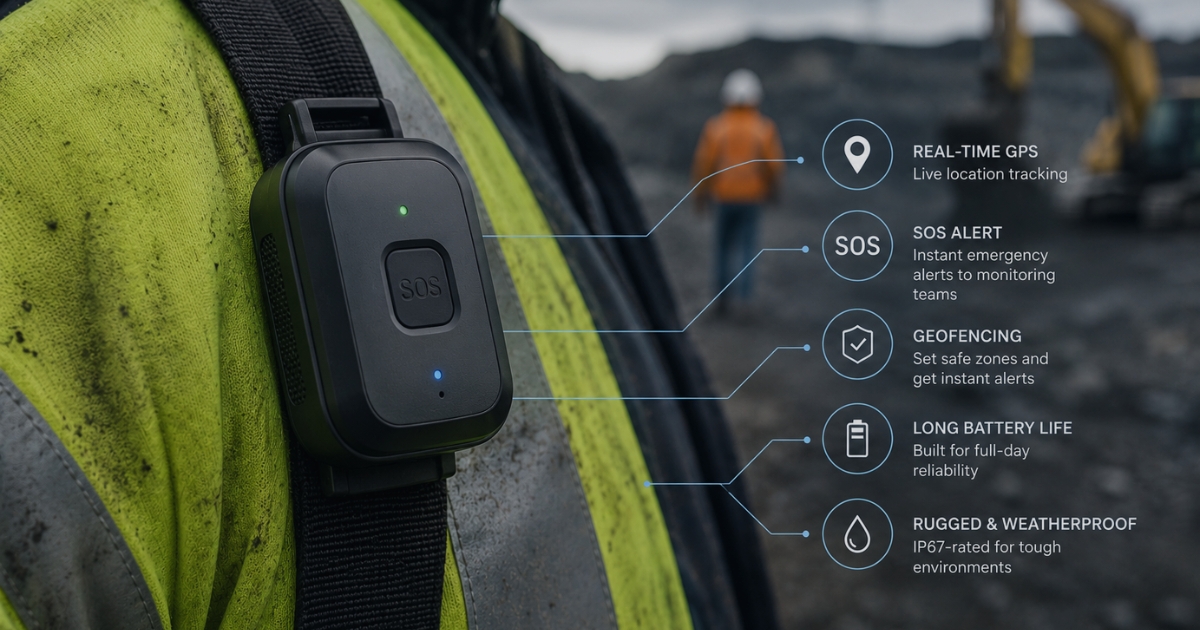
Use case for Cat 1bis: connected personal safety device
A wearable GPS tracker designed for lone workers in field environments. The device reports precise location frequently, transmits environmental sensor data, and needs to operate over standard LTE wherever the worker is deployed globally – including regions where Cat-M network availability cannot be guaranteed. It also needs to receive periodic firmware updates reliably in the field. Cat 1bis delivers the coverage consistency, the data rate for responsive location services, and the FOTA capability to manage updates efficiently, all through a single antenna. Power consumption is higher than LTE-M, but this device has a larger form factor and charging infrastructure available, making the trade-off acceptable.
LTE Cat 4 – High Throughput When the Data Demand Justifies It
LTE Cat 4 is the highest-capability option in this comparison, delivering up to 150 Mbps downlink and 50 Mbps uplink through 2×2 MIMO. That performance comes with real costs: higher power consumption, a larger module footprint, the highest BOM cost of the four, and the requirement for two antennas with their associated integration complexity. In the context of a wearable, these are genuine constraints that need to be justified by genuine data rate requirements.
| Dimension | LTE Cat 1bis |
|---|---|
| Network coverage | Standard LTE – worst deep-indoor performance of the four |
| Data rate | ~150 Mbps DL / 50 Mbps UL |
| Latency | Low– full LTE performance |
| Power consumption | High – not optimized for battery-constrained devices |
| Number of antennas | 2 (2×2 MIMO) |
| Radio module size | Larger |
| Module cost | Highest of the four |
| FOTA capability | Excellent – high throughput and low latency make large updates fast |
Cat 4 is the right choice when nothing else can deliver the throughput you need – not a default. If your wearable is streaming continuous high-resolution video or handling large bidirectional data flows in real time, this is where you end up. For anything less demanding, the power, size, and cost penalty is difficult to justify.
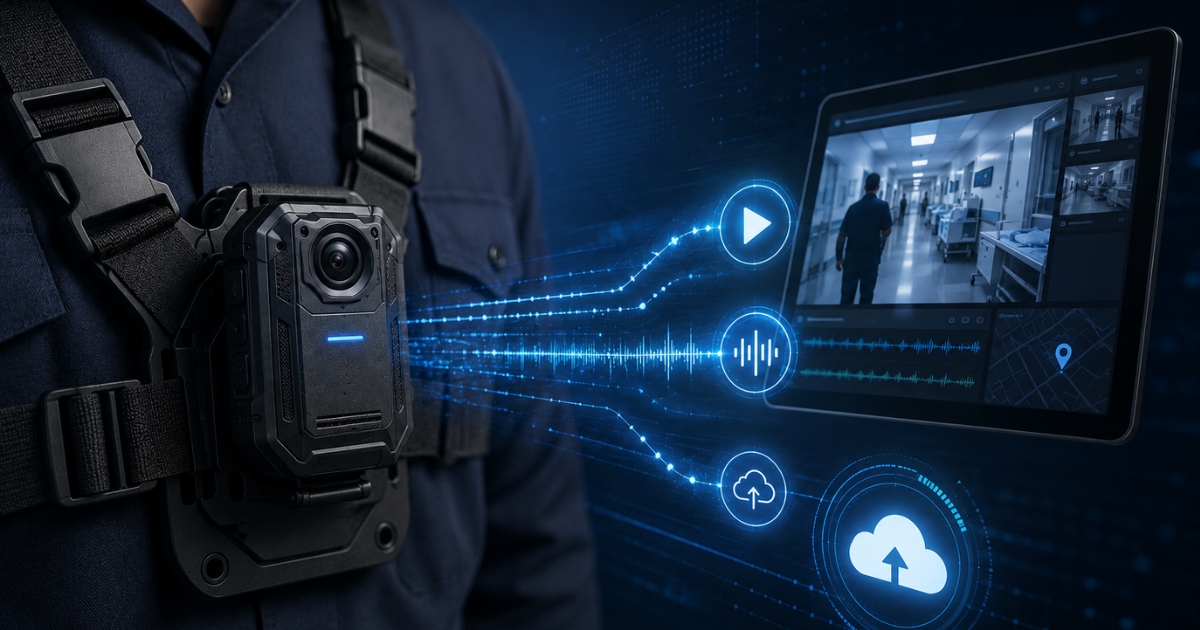
Use case for LTE Cat 4: body-worn camera for healthcare or security
A wearable camera system worn by a clinician or security officer that streams live HD video to a monitoring platform and receives real-time audio and instructions in return. The data rate requirement is non-negotiable: anything lower will compress quality to the point of defeating the product’s purpose. The device is worn in a harness with meaningful physical volume available and is charged between shifts. Cat 4’s power and size trade-offs are acceptable in this form factor precisely because the throughput requirement cannot be met any other way. The FOTA capability is also a bonus – large system images update quickly and reliably.
| Dimension | NB-IoT | LTE-M | LTE Cat 1bis | LTE Cat 4 |
|---|---|---|---|---|
| Network coverage | ★★★★★ | ★★★★☆ | ★★★☆☆ | ★★★☆☆ |
| Data rate | ~26 kbps | ~1 Mbps | ~10 Mbps | ~150 Mbps |
| Latency | High | Low–moderate | Low | Low |
| Power consumption | Extremely low | Low | Moderate | High |
| Number of antennas | 1 | 1 | 1 | 2 |
| Radio module size | Very small | Small | Medium-small | Larger |
| Module cost | Lowest | Low | Moderate | Highest |
| FOTA capability | Limited | Good | Strong | Excellent |
| Mobility support | Limited | Full | Full | Full |
One More Practical Note: Verify Operator Support Early
NB-IoT and LTE-M are broadly deployed by mobile network operators globally, and many operators support both on the same physical LTE network. That said, coverage, roaming agreements, and network configuration vary meaningfully by region and operator. LTE Cat 1bis and Cat 4 are available wherever standard LTE is deployed, which gives them an advantage in regions where Cat-M rollout is still maturing.
Before finalizing your technology choice, validate your target operators’ support and roaming coverage for the regions your device will operate in. Discovering a coverage gap at the integration stage is a much more expensive problem than discovering it during technology selection.
The Technology Is Only Half the Problem
Choosing the right cellular standard narrows the design space considerably – but it does not close it. Once you have committed to a technology, the antenna integration challenge begins in earnest.
Wearables impose conditions that antenna design handles poorly if approached generically. The human body absorbs RF energy, detuning antennas and reducing efficiency in ways that benchtop testing will not reveal. The physical space constraints mean standard antenna formats rarely fit without modification. Two-antenna configurations for Cat 4 require careful placement and isolation work. And regulatory compliance – SAR limits in particular – adds another layer of constraint that feeds directly back into antenna design decisions.
If you want to go deeper on what cellular antenna design looks like in practice for IoT and connected devices, our antenna design for cellular page covers the technical fundamentals, integration considerations, and common failure modes in detail.
For the full picture of how antenna design changes when the device is a wearable – body proximity effects, form factor constraints, regulatory requirements, and the testing that validates it all – take a look at our antenna design for IoT page.
Choosing the right technology is the start. Getting the antenna right is what determines whether it actually works.
Leave A Comment